Machine Learning
This page is supposed to gather all the “wisdom” I have so far in Machine Learning.
What do I need to start?
Data
A representative set of data (the more complex the problem, the more data)
A label for each dataset, that describes the data
Data & labels must be divided into
training data
training labels
validation data
validation labels
where the training data is usually about 75% of the data, 25 % for validation
Additionally you might reserve some for testing (60 % training, 20 % validation, 20 % testing)
test data
test labels
Hint
To tune your model based on the validation set leads to overfitting towards it, especially when having little data. Validation data should change during training. Two ways:
k-fold validation: Divide training & validation into same sized batches, assign one to validation and the rest to training. Train as many times as there are batches, each time using a different batch as validation set. Lastly, calculate the mean of all iterations.
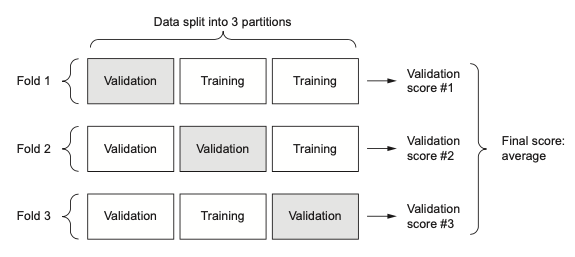
Three-fold validation (three data batches)
k-fold validation, done multiple times (same batch sizes), while shuffling all data before creating batches.
Transform data into tensors (1D, 2D, 3D, or more):
2D: Vector data (samples, data_values)
3D: Timeseries data or sequence data (samples, time_or_sequence, data_values)
4D: Image data (samples, height_index, width_index, color_channel_values)
5D: Video data (samples, frame, height_index, width_index, color_channel_values)
One-Hot Encode the labels: 2D tensor (sample, label):
Label tensor shape must be (amount_of_data_samples, amount_of_classes)
Make sure the data range of all values is similar. Having one feature ranging from 0 to 1 and another from 100 to 10000 is problematic. A best practice is normalization:
\[val_{new} = \frac{val - \mu}{\sigma}\]Subtract the mean value of a feature and divide by its standard deviation. This result into all values ranging around zero.
Add missing data (if applicable): Missing data fields can be assigned to 0 (if that is not a meaningful value)
Weight regularization
The goal is to have as small weights as needed to sufficiently describe the data (even though larger weights might do this just as good), in order to reduce the chance of overfitting.
The most common ones are L1 regularization and L2 regularization.
from keras import regularizers
model = models.Sequential()
model.add(layers.Dense(16, kernel_regularizer=regularizers.l2(0.001),
                       activation='relu')
model.add(layers.Dense(16, kernel_regularizer=regularizers.l2(0.001),
                       activation='relu'))
model.add(layers.Dense(1, activation='sigmoid'))
There is no rule, which one to choose: try both and see which performs better.
Selection of the loss functions
Take this table as a starting point of choosing your loss function:
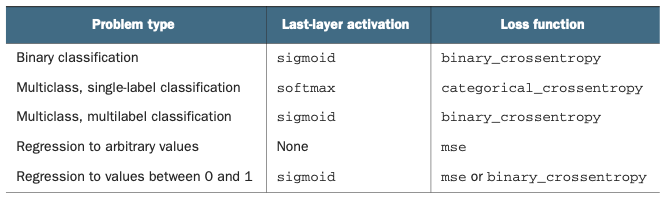
Choosing the last-layer activation function and loss function
- categorical_crossentropy:
Measures the distance between the classifier’s predictions and the labels. The lower the loss, the better the classifier. Also referred to as Cross-Entropy.
Suitable for: Good choice for categorical data (“Does this dataset belong to a certain category?”)
- mse (mean squared error):
Measures the square of the difference between the predictions and the targets.
Suitable for: The mean squared error is a widely used loss function for regression problems (Regression means, prediction of a value).
Selection of the observed metrics
See all available models: tf.keras.metrics.
- accuracy:
Calculates how often predictions equals labels.
Used for: classification
- mae (Mean absolute error):
It’s the absolute value of the difference between the predictions and the targets.
Used for: Scalar regression (single value prediction)