Rules for Render Logic: Pure Components
Two types of logic in React components:
Render logic
Code that lives at the top level of the component function
Participates in describing how the component view looks like
Event handler function
Executed as a consequence of the event that the handler is listening for (
changeevent for example below)code that actually does things: update state, perform an HTTP request, read an input field, navigate to another page etc.
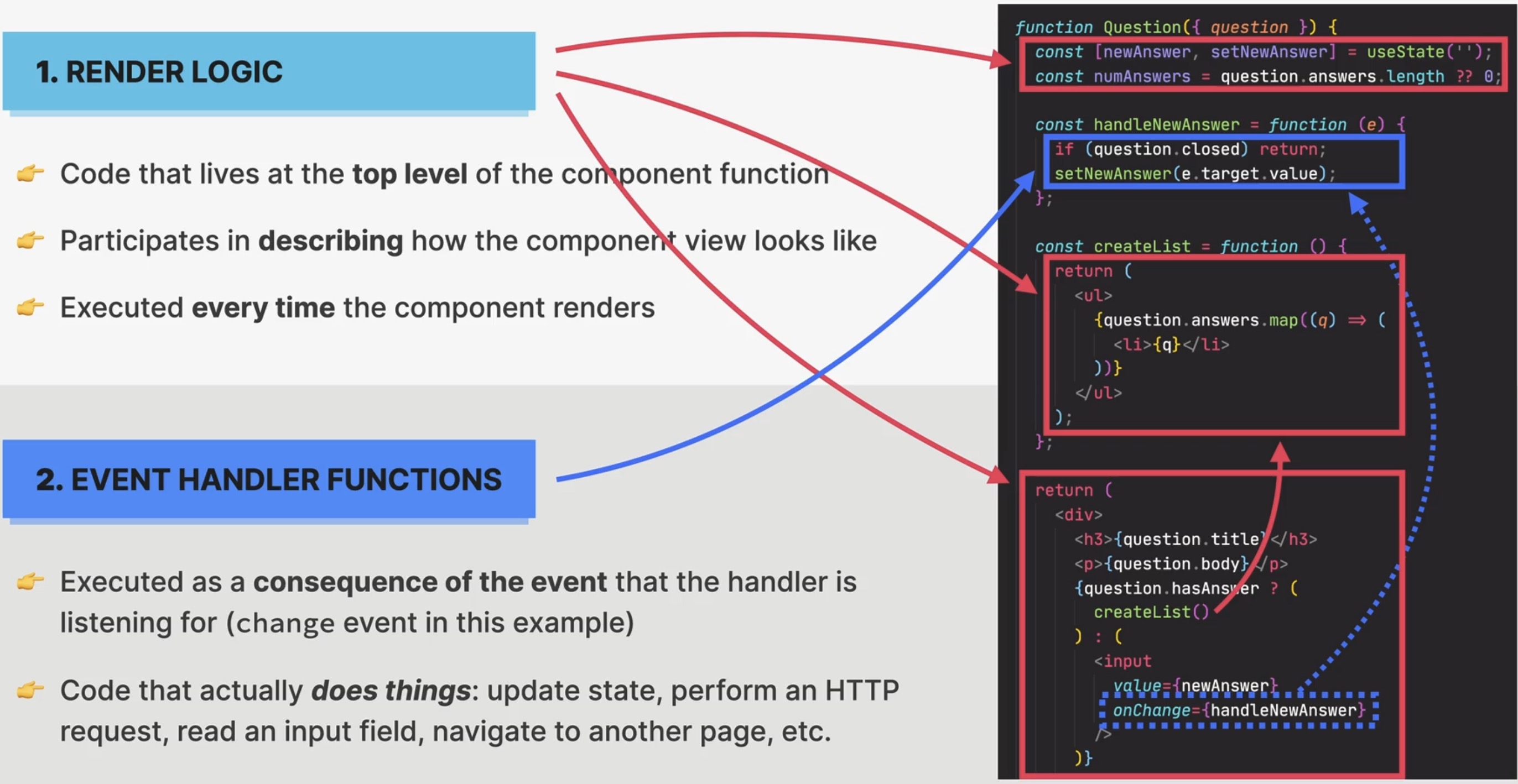
Two types of logic in React components
Functional programming principles
Side effect:
Dependency on or modification of any data outside the function scope. Examples: mutating external variables, HTTP requests, writing to DOM
Hint
Side effects are not bad! A program can only be useful if it has some interaction with the outside world.
Pure functions:
A function that has no side effects (don’t change any variable outside of their scope)
Given the same input, a pure function always returns the same output
Rules for render logic
Components must be pure when it comes to render logic: given the same props (input), a component instance should always return the same JSX (output)
Render logic must produce no side effect: no interaction with the “outside world” is allowed:
Do NOT perform network requests (API calls)
Do NOT start timers
Do NOT directly use the DOM API (e.g. register event listeners)
Do NOT mutate objects or variables outside of the function scope –> this is why we can’t mutate props! (hard rule of React)
Do NOT update state (or refs): this will create an infinite loop!
Important
Side effects are allowed (and encouraged) in event handler functions!
There is also a special hook to register side effects (useEffect).