Facade Pattern
Issue
Following the Single Responsibility Principle, that each class is only supposed to be responsible for one particular thing is likely to lead to lots of classes
As a consequence, a lot of classes needs to be used in order to do something meaningful inside an application
Solution
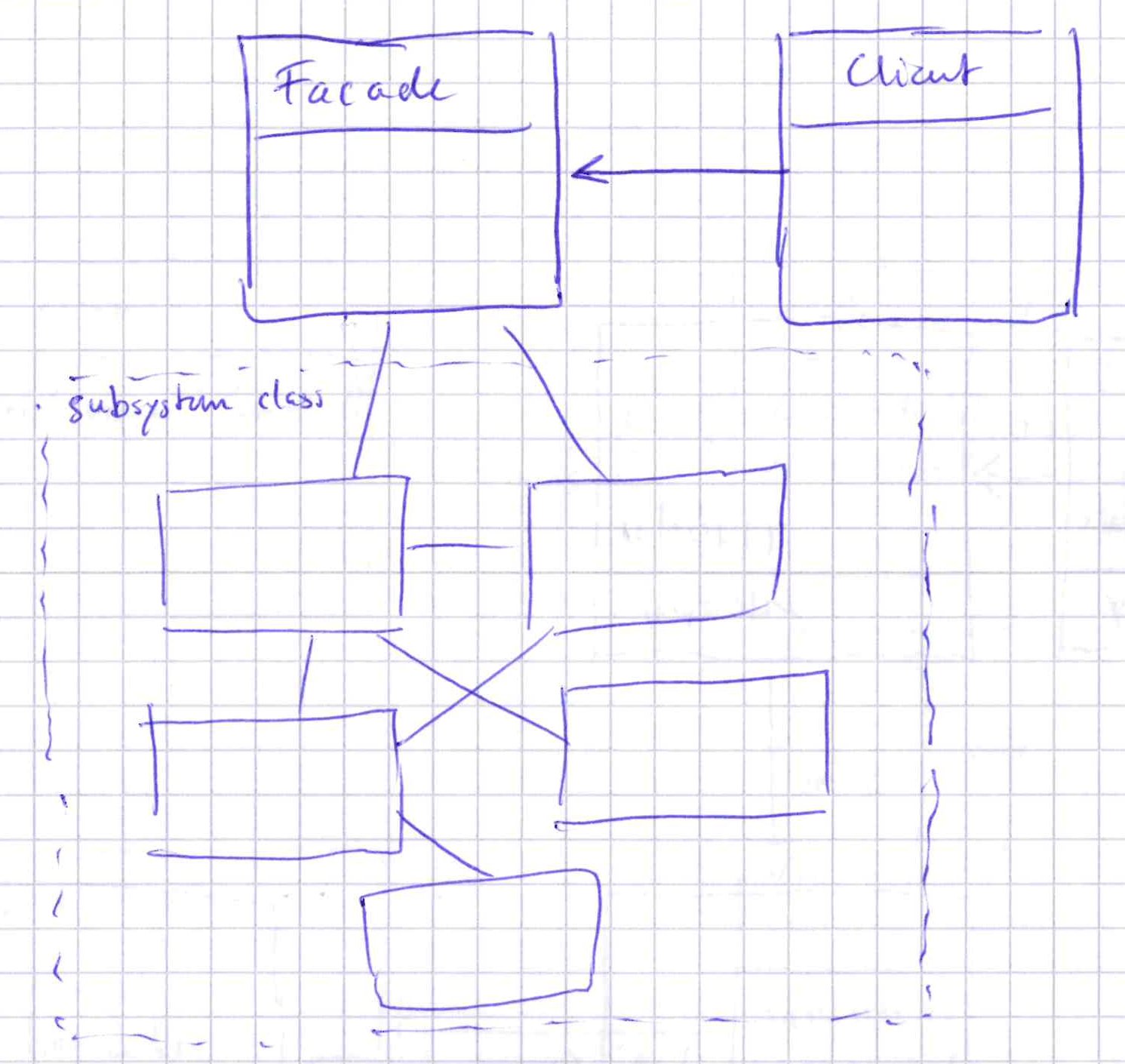
Complex wiring of classes is OK, but created a facade enables to cover up all internal complexities
A Facade class covers all this complexity inside a single method
A Client then can access those Facade methods without having to access the subsystem classes -> coupling is reduced to a minimum
Design Principle 1
Principle of Least Knowledge: talk only to your immediate friends
It promotes to reduce the amount of classes one class interacts with. Every interaction of one class (Class A) with another class (Class B) potentially requires an adaptation of the Class A in case Class B changes. It’s costly to maintain, but also harder for others to understand.
Definition
The Facade Pattern provides a unified interface to a set of interfaces in a subsystem. Facade defines a higher-level interface that makes the subsystem easier to use.
Find a template example for Python at https://refactoring.guru/design-patterns/facade/python/example.