Template Method Pattern
A Template is a class which contains template methods
A template class might leave gaps for subclasses to fill i.e. abstract methods
A subclass of a template class is a concretization of the template class
Invariant parts -> Base class
Variant parts -> Concrete subclass
Example for applications following the Open-Closed Principle
The concrete implementation fo the template class is then instantiated for usage
Principles & Definition
Hollywood Principle
Don’t call use, we call you.
Definition
The Template Method Pattern defines the skeleton of an algorithm in a method, deferring some steps to subclasses. Template Method lets subclasses redefine certain steps of an algorithm without changing the algorithm’s structure.
        classDiagram
    AbstractClass <|-- ConcreteClassA
    AbstractClass <|-- ConcreteClassB
    class AbstractClass{
        +template_method()
        +operation_1()*
        +operation_2()*
    }
    class ConcreteClassA{
    }
    class ConcreteClassB{
    }
operation_1() &operation_2() are abstract methods
the template_method() uses the abstract operations within its own implementation (abstract operations: subclasses define the concrete operation methods)
that way we cannot say what the template_method() actually does, but only know about its structure
the Template Method Pattern is similar to the Strategy Pattern, but the Template Method Pattern defines invariant parts that are certain to stay valid over time whereas the Strategy Pattern does not
the Template Method Pattern is often used for frameworks, where the interface must stay solid for users to use it
COPIED FROM EVERNOTE
CAUTION: Think careful, if your system applies for the Template Pattern, because the Strategy Pattern might suffice here (and doesn’t state invariable parts) * The TemplateMethod() could be replaced by a set of behavior methods injected by Strategy classes and methods * The execution order would be fix, but the methods itself can be changed for all concrete implementations of the composing interface * Composition should be preferred over inheritance and the Template Pattern is built around inheritance
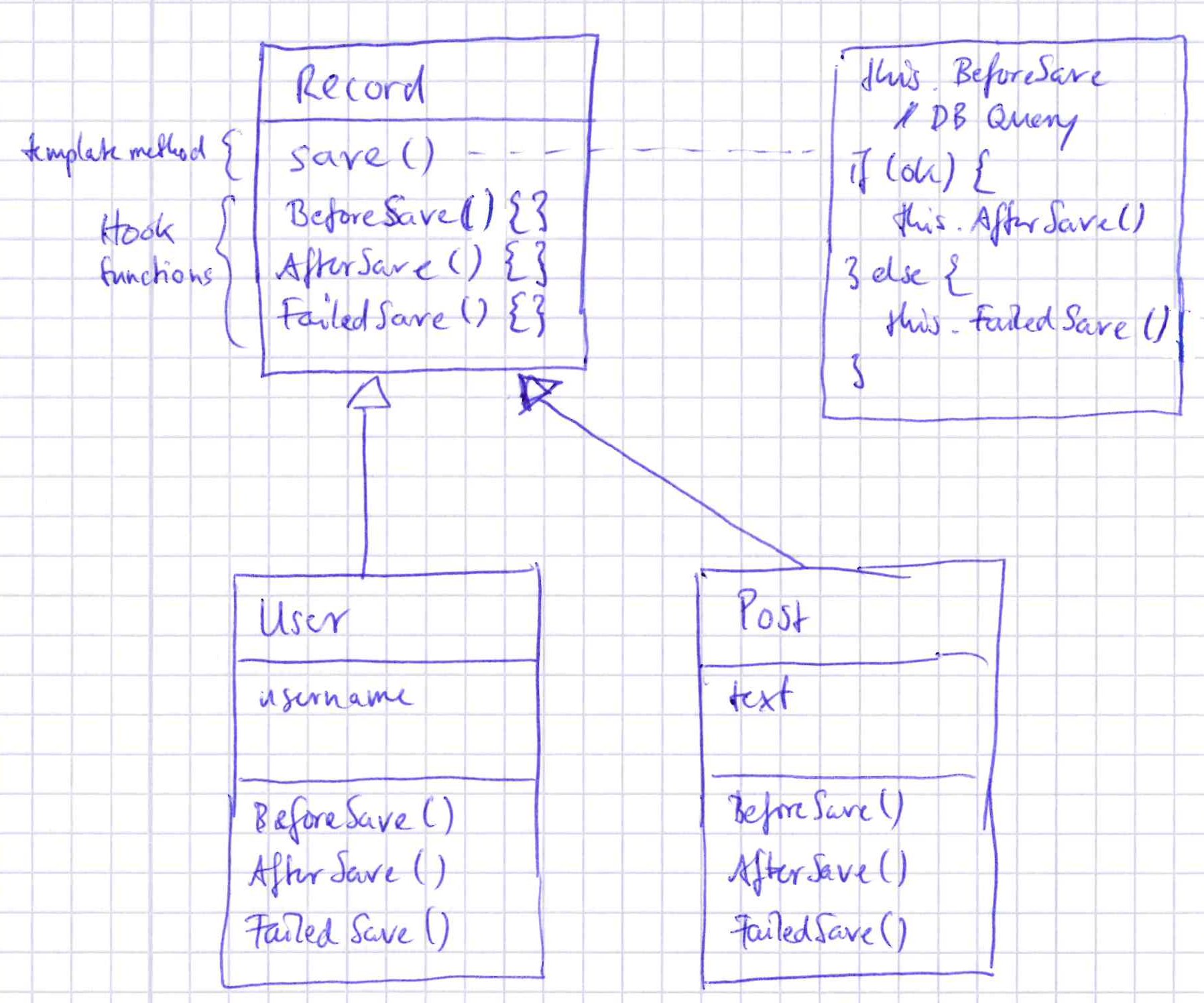
Example: Blog Posts System with database save
Hook operations: * provides an empty implementations * concrete subclasses may override the hook functions
Hollywood Principle (Don’t call us, we call you): * The Record class says to the User not to worry about saving a User object. If anything fails, Record will call the User’s FailedSave() method